Years ago, I was looking at the reflection of trees in the water.
There was snow resting on the branches, and the reflection was remarkably clear. I could see the trees, the branches, even the snow. But as the water moved, the image moved with it. What I was looking at was real, but it was distorted.
Then I looked up at the actual trees.
I remember thinking that this is often how I see the circumstances of my life.
The circumstances are real. The pain may be real. The uncertainty may be real. But by the time what is happening passes through my emotions, assumptions, fears, expectations and past experiences, I can begin treating my interpretation of the circumstances as though it is the circumstances.
The reflection wasn't imaginary. It just wasn't capable of showing me the trees exactly as they were.
I think our minds can do something similar.
Fear Has an Imagination
I learned a lot about this during one of the most painful seasons of my life.
For 21 months, I didn't see or speak to one of my sons.
He was still very young when circumstances outside of my control separated us. I had been his primary parent his entire life, and then suddenly I couldn't call him. I couldn't see him. I couldn't tell him I loved him.
Birthdays and holidays passed without him.
I knew he was hurting. I believed he was in a situation that wasn't good for him. Eventually, after months of fighting to change the circumstances, I made the excruciating decision to stop fighting in the way I had been fighting and release something I desperately wanted to control.
I didn't know when—or honestly, if—my son would ever come home.
There was nothing small about that kind of uncertainty. And my mind knew exactly what to do with it.
It imagined.
It imagined what might be happening. It imagined what could happen next. It imagined all of the ways this story could go terribly wrong.
Fear has a surprisingly active imagination.
The interesting thing about rumination is that it can feel like we're dealing with reality. We rehearse conversations that haven't happened. Predict outcomes that haven't occurred. Fill in information we don't have. And because the possibilities we're imagining are frightening, they can begin to feel like facts.
I did plenty of that.
I would like to say that what I learned to do next happened more often than the negative ruminating. It didn't.
I had to practice.
Imagining the Possibilities of God
Somewhere in that season, I began practicing something different.
Instead of spending all of my time ruminating on the circumstances—or all of the likely negative things that were currently happening or could happen—I would allow myself to imagine what might be possible with God.
I would call to mind Ephesians 3:20 and remember that God is able to do abundantly more than I could ask or imagine. And then I would let myself wonder.
What might God be doing that I couldn't see?
What possibilities existed beyond the ones fear kept offering me?
What could God do that was more than I could even think to ask for?
Some of the possibilities that came to mind were wonderful and hopeful and amazing. Oh, how my heart ached for those things to truly be possible.
But the interesting thing was what happened inside of me when I allowed myself to imagine them.
My circumstances didn't change. My son was still gone. I was still waiting. I still didn't know how the story would end.
But I felt different.
I felt lighter. Hopeful. Confident. Dare I say, even joyful.
I began discovering this during those 21 months of waiting. Imagining the possibilities with God was simply a better place for me to be. It brought hope and peace and joy.
It didn't change the circumstances. It was a practice.
And it was crazy to notice the difference. Nothing had changed around me. Something had changed in the way I was holding what was happening.
This Is Not Manifesting
I want to make something very clear.
This was not manifesting.
I wasn't imagining a particular outcome in an attempt to make it happen. I wasn't trying to create my future with my thoughts. And I certainly wasn't deciding what God needed to do.
The actual outcomes weren't the point at all. In some ways, this practice was the exact opposite of trying to control the outcome.
It was about learning how to fully trust God no matter what happened.
During that season, I had already wrestled with this deeply. I had to decide over and over again whether I was going to trust God with my son. I had come to the place where I knew that my faith in God could not depend on the outcome.
Even if He never brought my son home, He could still be trusted.
That's hard for me to write. It was even harder to live. Because of course I wanted my son home.
But I get to walk with the Lord in His will, not mine.
Imagining the possibilities of God wasn't about deciding which possibility I wanted and asking God to make it happen. It was allowing fear to stop being the only voice with permission to imagine the future.
Fear didn't know what was going to happen either.
Learning to Trust the Heart of the Father
I think about this now as a parent.
I would love for my kids to truly see my heart for them. I would love for them to know the depths of my love for them so completely that even when they don't understand what I'm doing, they feel free to imagine my good and loving intentions toward them.
They might not correctly predict what I will do. That's not the point. I would simply want them to know me well enough to trust my heart.
Imagine how much more our Heavenly Father does this.
There are so many things I cannot see from where I am standing. So many things I don't understand. So many endings I cannot predict.
But I can know Him.
And because I know something of His heart, I don't have to assume that the worst thing I can imagine is the truest thing.
I can leave room for possibility. I can wonder. I can hope.
And then I can release every possibility I've imagined right back into His hands.
The Story I Couldn't Imagine
There is something else I need to tell you about this particular story.
My son did come home.
After 21 months without seeing or speaking to him, he reached out to my family. Eventually he called me. He wanted to come home. Within days, by God's grace, he was home and safe.
I got to put the fifth plate back on our dinner table. I got to hear him call me Mom again. I got to hug my son.
And God wasn't finished.
There has been healing and restoration in our family that I could not have orchestrated myself. In some ways, God has already done far more than I asked or imagined.
But I hesitate even as I write that, because I don't want you to miss the point.
My son's return isn't proof that this practice worked.
This isn't a formula. I didn't imagine hard enough and get the ending I wanted.
And if you are reading this while still waiting for the thing you desperately want God to restore, I don't want my story to become another reason you wonder why He hasn't done the same thing for you.
The lesson wasn't trust God and He will give you the outcome you imagined.
The lesson was:
Trust God.
That was true while my son was gone. It was true the day he came home. And it would still be true if I were waiting today.
Look Again
Maybe learning to see differently isn't about convincing ourselves that something painful is actually good. Maybe it isn't about finding the positive side of every difficult circumstance. And maybe it isn't even about finding the “right” interpretation.
Maybe sometimes it simply means recognizing that the reflection isn't the whole picture.
Fear will happily fill the unknown with its possibilities. But fear doesn't know the future.
Neither do I.
So when I notice myself staring into the reflection—turning over everything that might happen, rehearsing everything that could go wrong, treating my interpretation as though it were the whole story—I can look again.
I can acknowledge what is actually true. I can notice what fear has added. And then I can remember the Father whose perspective is so much greater than mine.
What might be possible with God?
I don't ask that question because I know what He will do. I ask it because I know Who He is.
And sometimes making room for that possibility is enough to loosen my grip, quiet my fear, and help me trust Him with the story I cannot yet see.
Scripture to Reflect On
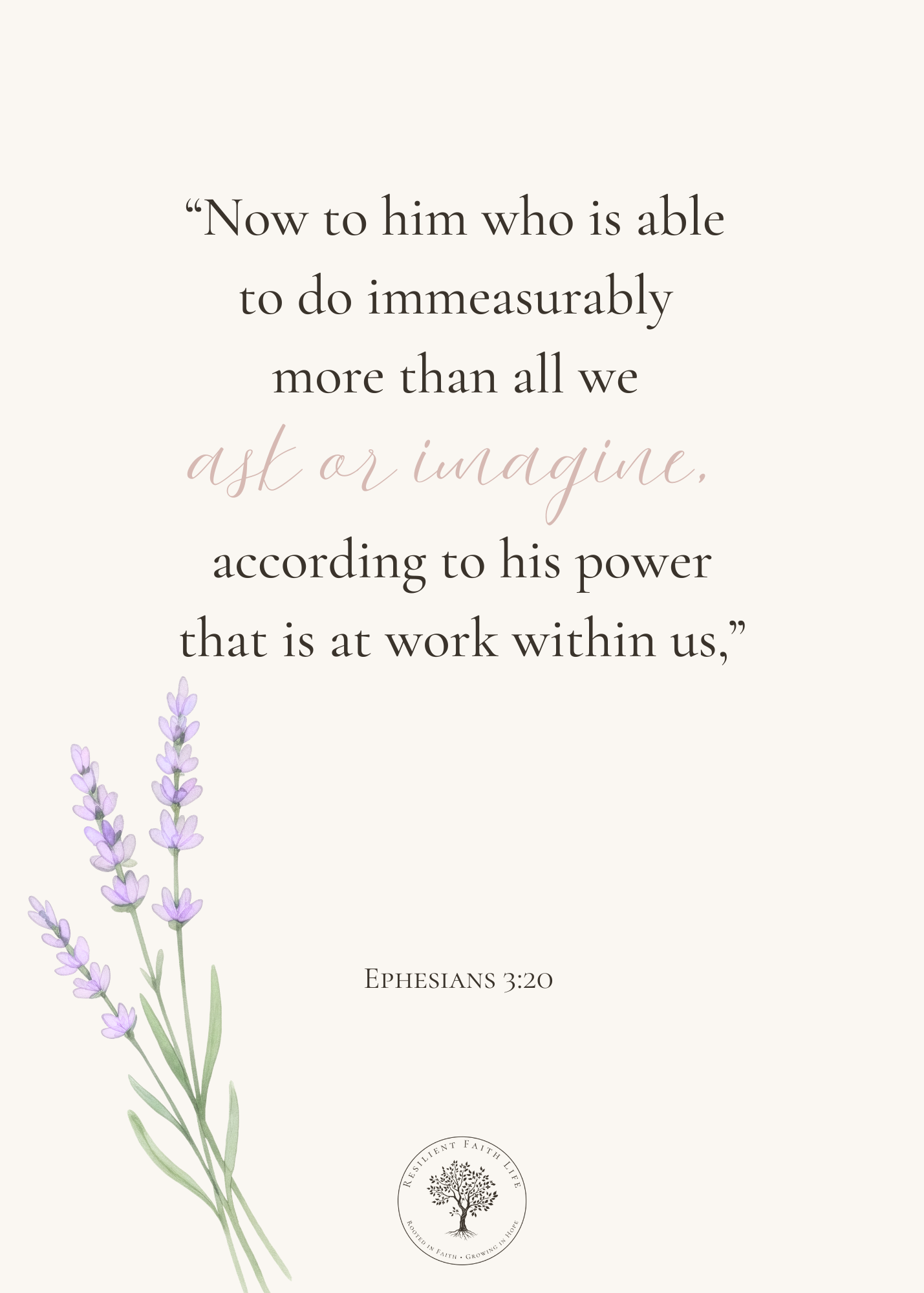
Download the free Ephesians 3:20 Scripture card as a reminder that God is able to do more than we can ask or imagine, even when we cannot see what comes next.
Continue Reflecting
If you’d like to spend more time with this theme, explore Imagining the Possibilities of God, a guided reflection to help you make room for hope and trust God with the outcome. Available for purchase in the Resilient Faith Life Etsy shop.