There was a season of my life when I became very serious about growth.
I wanted to be healthier. More disciplined. More intentional. A better wife. A better mom. Better with money. Better at work. Better at managing our home.
Even my relationship with God somehow found its way onto the improvement list.
None of those desires seemed particularly bad. In fact, most of them sounded responsible. Faithful, even.
But somewhere along the way, growth stopped feeling like growth.
It started feeling like fixing.
And once I started looking for things to fix, I found them everywhere. There was always another habit I could improve. Another relationship I could handle better. Another goal I hadn't reached. Another book I hadn't read. Another spiritual practice I could add.
The more closely I looked at my life, the more deficiencies I seemed to find. Eventually, I realized that all of my efforts to become better weren't actually making me better.
They were making me miserable.
When “better” is never enough
I wrote about this realization in 2016. At the time, I could see that my relentless focus on improvement was feeding a familiar message inside me:
You aren't good enough yet.
What strikes me now is how easily that message can disguise itself as growth. It doesn't necessarily say, You're terrible.Sometimes it sounds much more respectable.
You could be doing more. You should have figured this out by now. If you were more disciplined, this wouldn't be a problem. Once you finally fix this part of yourself, then you'll be okay.
So we try harder. We read another book. Start another routine. Make another goal. Analyze another weakness. Develop another plan.
Even spiritual growth can become one more arena in which we measure ourselves. And without realizing it, we can begin relating to ourselves as though we are an endless improvement project.
I don't think that's the invitation of Jesus.
What I couldn't quite see yet
Back in 2016, I knew something wasn't working.
I knew gratitude mattered. I knew I needed time with God. I even wrote that when something surfaced that made me feel “not good enough,” maybe my first response should be prayer rather than immediately trying to fix it.
I think I was beginning to see something then that would take years for me to understand more fully:
Transformation is not something I manufacture. God is the One who forms me.
That doesn't mean growth doesn't require my participation. Scripture is full of invitations to obedience, repentance, perseverance, wisdom, discipline, and change. But participation is very different from taking responsibility for my own transformation.
There is a subtle form of control hidden in that responsibility. If I can identify everything that is wrong, make the right plan, work hard enough, and become disciplined enough, perhaps I can guarantee the outcome.
But control can be its own form of unbelief.
It quietly assumes that everything depends on me. That I need to manage the process, produce the change, and secure the outcome rather than trust the One who is already at work within me.
Surrender doesn't mean I stop participating. It means I stop trying to take God's place in the process.
There are things that are mine to do—things to confess, choices to make, habits to change, acts of obedience to take. But transformation belongs to God. My invitation is to stay close enough to hear Him, trust Him, and faithfully respond to what He is doing.
Jesus gives us a beautiful picture of this. In John 15, He doesn't tell His disciples to work harder at producing fruit.
He tells them to abide.
Remain in Me.
The branch isn't responsible for creating life. Its responsibility is connection to the source of life. Fruit grows from there.
From fixing to receiving
Years after I first wrote about becoming “grumpy” from all my growing, God continues to bring me back to this same truth in deeper ways.
I wish I could say that I learned this lesson once and stopped striving. I didn't.
Performance is still an easy place for me to drift. I can find myself slipping back into measuring, managing, fixing, and trying harder—sometimes before I even realize I've done it.
But perhaps part of the growth is that I am learning to notice.
I'm learning to recognize the feeling of performance sooner. I'm becoming more familiar with the internal pressure that tells me something depends entirely on me. And instead of treating that awareness as evidence that I've failed at yet another thing, I'm learning to let it become an invitation back to God.
There I go again, Lord.
And I can bring it to Him. Not after I've figured out why I'm doing it. Not after I've corrected myself. Not after I've managed to become less controlling or more trusting.
Right there.
I can pray. I can listen. I can receive.
This is still very much a process for me. And maybe that's part of what I'm learning about spiritual formation too. Growth doesn't always mean we stop struggling with something. Sometimes growth looks like recognizing more quickly where we've wandered and knowing where to return.
I still notice how often my first instinct is to respond to something by fixing it. A difficult emotion. A painful relationship. A weakness. A fear. A reaction I don't like.
Even when my desire for change is good, I can move so quickly toward What should I do about this? that I skip something much more important:
Jesus, what do You want me to receive here?
Maybe truth. Maybe conviction. Maybe comfort. Maybe wisdom. Maybe an invitation to repent. Maybe the reminder that I am loved before I get this right.
Maybe simply His presence.
Receiving doesn't mean we never respond. It changes where the response begins.
Instead of starting with my deficiency, I can begin with His sufficiency. Instead of allowing “not good enough” to send me scrambling toward self-improvement, I can bring that place to Jesus.
And then I can let Him show me what is actually mine to do.
Growth can be gentler than we think
Trees don't strain to produce growth rings. They remain rooted. They receive what sustains them. And season after season, growth happens.
Some seasons bring abundance. Others bring drought. Some leave scars. Some produce barely visible growth at all. But over time, the rings tell the story of a life that has continued to grow.
I wonder if our spiritual lives are more like that than we sometimes imagine.
Maybe we don't need to wake up every morning scanning ourselves for deficiencies. Maybe we can become curious instead.
Where is God already at work?
What is He inviting me to receive?
What truth is He showing me?
Is there something He is asking me to release?
Is there one faithful response He is inviting me into today?
That kind of growth doesn't require us to become passive. It requires us to stay close.
Because resilient faith isn't built by finally getting ourselves fixed. It grows as we become increasingly rooted in the One who is already at work within us.
An invitation
If there is an area of your life right now that immediately brings up the feeling I'm not good enough, perhaps you don't have to make a plan to fix it today.
You could simply bring it to Jesus. Sit with Him there for a moment. Ask Him what He wants you to know.
And before deciding what you need to do next, give yourself space to receive.
Scripture to Reflect On
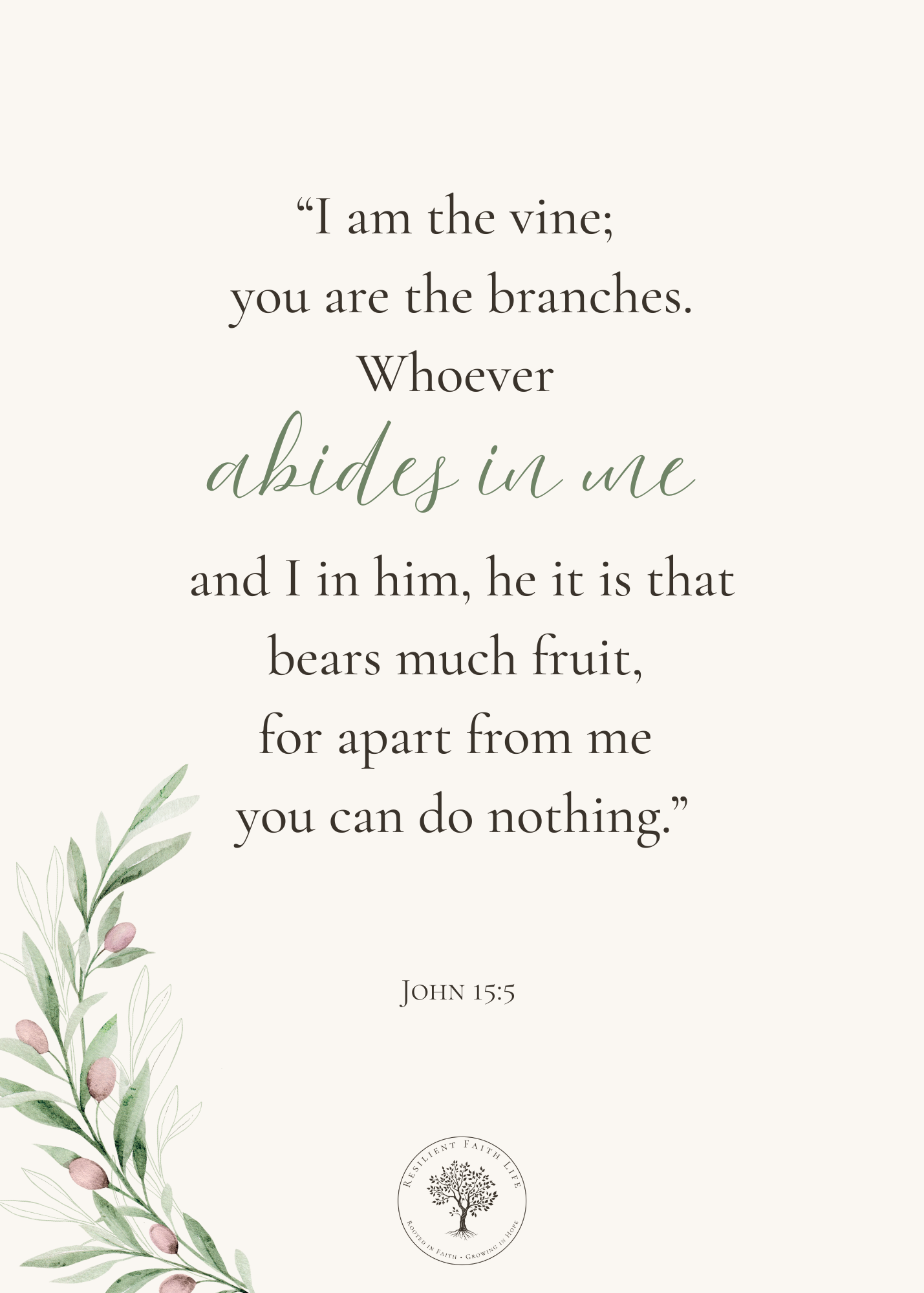
“I am the vine; you are the branches. Whoever abides in me and I in him, he it is that bears much fruit, for apart from me you can do nothing.”
John 15:5 — ESV
A Scripture to Keep Close
Download the free John 15:5 Scripture card as a reminder to abide in Christ throughout your day.
Continue Reflecting
If you’d like to spend more time with this theme, explore From Striving to Abiding, the companion guided reflection available for purchase in the Resilient Faith Life Etsy shop.